
October 6, 2026
Acumen
Shift from Volume to Value
As over 6,500 admissions leaders gather in Minneapolis for NACAC 2026 (8–10 October), higher education faces a critical turning point: sustaining international enrolments as pipelines contract across North America.
Decade-long growth relied on volume—more enquiries, applications, and offers. Today, policy shifts, study permit caps, visa restrictions, and processing bottlenecks strain that model, causing severe drop-offs from application to arrival.
To thrive, institutions must transition from chasing sheer application volume to maximizing yield: screening earlier, deciding faster, and converting a higher proportion of admitted students.
The numbers behind the shift
The pipeline narrowed at every stage in 2025–26, in both markets.
| Market | Indicator | What happened |
| US | New international enrolment, fall 2025 | Down 17% year on year (IIE / State Dept, via CNBC) |
| US | International applicants, Common App 2026–27 | Down 10%, the steepest drop on record, while overall volume rose (CNBC) |
| US | Projected total enrolment, fall 2026 | Down 9.5%, about 111,000 fewer students (NAFSA) |
| US | Institutional outlook, 2026–27 | Nearly two-thirds of IIE Spring 2026 respondents expect further declines (NAFSA) |
| Canada | Study permit cap, 2026 | 408,000 permits, 155,000 for new arrivals; 7% below 2025 and 16% below 2024 (CIC News) |
| Canada | Study permit holders | From over 1 million (Jan 2024) to about 725,000 (Sep 2025) (Envoy Global) |
The drivers are policy, not demand. In the US, a December 2025 executive order restricted visas for nationals of 39 countries, and appointment delays keep admitted students from arriving on time. In Canada, the cap continues to squeeze new intake.
There is a data problem too. Complete US government mobility statistics arrive 18 to 24 months late. Institutions planning for fall 2027 on official figures alone are steering by an old map.
Where the admissions funnel is leaking
Contraction across the student lifecycle manifests in four primary operational friction points:
- Recruitment: Delayed response times, inconsistent lead quality, and low conversion on agent-led channels.
- Admissions Bottlenecks: Processing backlogs driven by incomplete files, credential evaluation, and assessor constraints.
- Integrity & Compliance Risk: Elevated risk from fraudulent documentation and visa refusals directly eroding yield.
- Yield Leakage: Widening drop-off between offers, deposits, and arrivals—evidenced by 72% of US institutions issuing deferrals for spring 2026 (US News).
All of this lands on teams being asked to do more with less, as enrolment shortfalls turn into hiring freezes and budget cuts across the sector.
The Acumen Advantage: Integrated Solutions
Acumen brings 18+ years of global education expertise, 300+ in-market specialists across 15+ key regions, and a track record of supporting 120+ global partners, including 18 of the QS Top 100. Our core solutions address today’s recruitment and enrolment pressures:
Acumen Impact (AI-Enabled Admissions): Combining intelligent technology with expert human governance across five stages: Assess, Admit, Verify, Convert, and Enrol. Delivered natively within existing institutional CRMs to drive immediate efficiency gains:
| Outcome | Result |
| Manual processing | About 40% less |
| Team productivity | About 30% gain |
| Interview-screening effort | About 50% less |
| Manual effort on incomplete applications | Close to zero |
| Offer-to-enrolment conversion | About 10% uplift |
Screening earlier means teams spend their time on the applicants most likely to be genuine and to enrol.
Acumen Presence (In-Country Representation): Dedicated In-Country Representatives (ICRs) operating as seamless extensions of university teams. ICRs nurture high-school, counsellor, and agent networks, execute targeted local outreach, and drive prospect conversion directly on the ground—without the overhead of establishing foreign entities.
Acumen Insights (Market Intelligence): Real-time data and demand analytics via Acumen Insights, bridging the 18–24 month lag in official reporting and unlocking emerging growth corridors like Vietnam and Southeast Asia.
Transnational Education (TNE) & Partnerships: Strategic advisory, due diligence, partner identification, and delivery models (joint/dual degrees, articulation, branch campuses) that establish in-market academic footprints.
TNE opportunities in South and Southeast Asia
For US and Canadian institutions facing visa and permit headwinds, the fastest-moving TNE markets are in South and Southeast Asia, where regulators are opening new routes for foreign degrees.
| Market | What is open | Recent signal |
| India | Branch campuses for globally top-500 universities under UGC 2023 regulations; joint, dual and twinning programmes for the top 1,000; GIFT City under IFSCA (Mastersportal) | Five Letters of Approval and 16 Letters of Intent to 15 institutions as of August 2026 (Collegedunia); Illinois Tech is the first US university under the UGC framework (Leap) |
| Vietnam | Joint programmes, the main model; since 2024, branch campuses for globally top-500 universities | RMIT Saigon South licensed as the first branch campus under the new rules in August 2026 (ICEF Monitor) |
| Malaysia | One of the world’s most developed TNE hubs | Targeting 250,000 international students by 2030; Monash has announced a second campus (The PIE News) |
| Indonesia | Branch campuses and programmes tied to national skills priorities | President Prabowo met UK higher education leaders in January 2026 to discuss partnerships (THE) |
Not every opportunity needs a campus. Joint and dual degrees, articulation pathways and blended delivery offer lower-risk entry, and build a pipeline of students who can transfer to the home campus as mobility recovers.
Acumen supports institutions from first look to launch: market and regulatory insight, partner identification, and a local Presence team to run recruitment on the ground. Our South East Asia research, including a dedicated Vietnam TNE survey, is a good place to start.
Strategic Discussion Points for NACAC
- If you could fix one thing in your international admissions cycle before the next intake, what would it be?
- What share of your applications stall at “more information required”, and for how long?
- Does your institution have an AI position for admissions yet, or is it still team by team?
- Where tools are in place, have they removed the bottleneck or just moved it?
- How much of your admit-to-enrol gap is visa timing, and how much is conversion you can still influence?
Let’s talk in Minneapolis
The next cycle will reward quality over quantity. We would welcome the chance to hear what is keeping your team up at night and share what we are seeing across our active markets.
Book a time to meet the Acumen team at NACAC, or join our TNE webinar on 20 October.
- Sheena / Aayushi to brief creatives: the data table and the five-stage Impact flow suit carousel slides
Sources: NACAC Conference 2026 · CNBC, Aug 2026 · NAFSA Fall 2026 Outlook · US News · CIC News · Envoy Global
Share
Recent Posts
Acumen at NACAC 2026: Driving Value in International Admissions
October 6, 2026
Shift from Volume to Value As over 6,500 admissions leaders gather in Minneapolis for NACAC 2026 (8–10 October), higher education faces a critical...
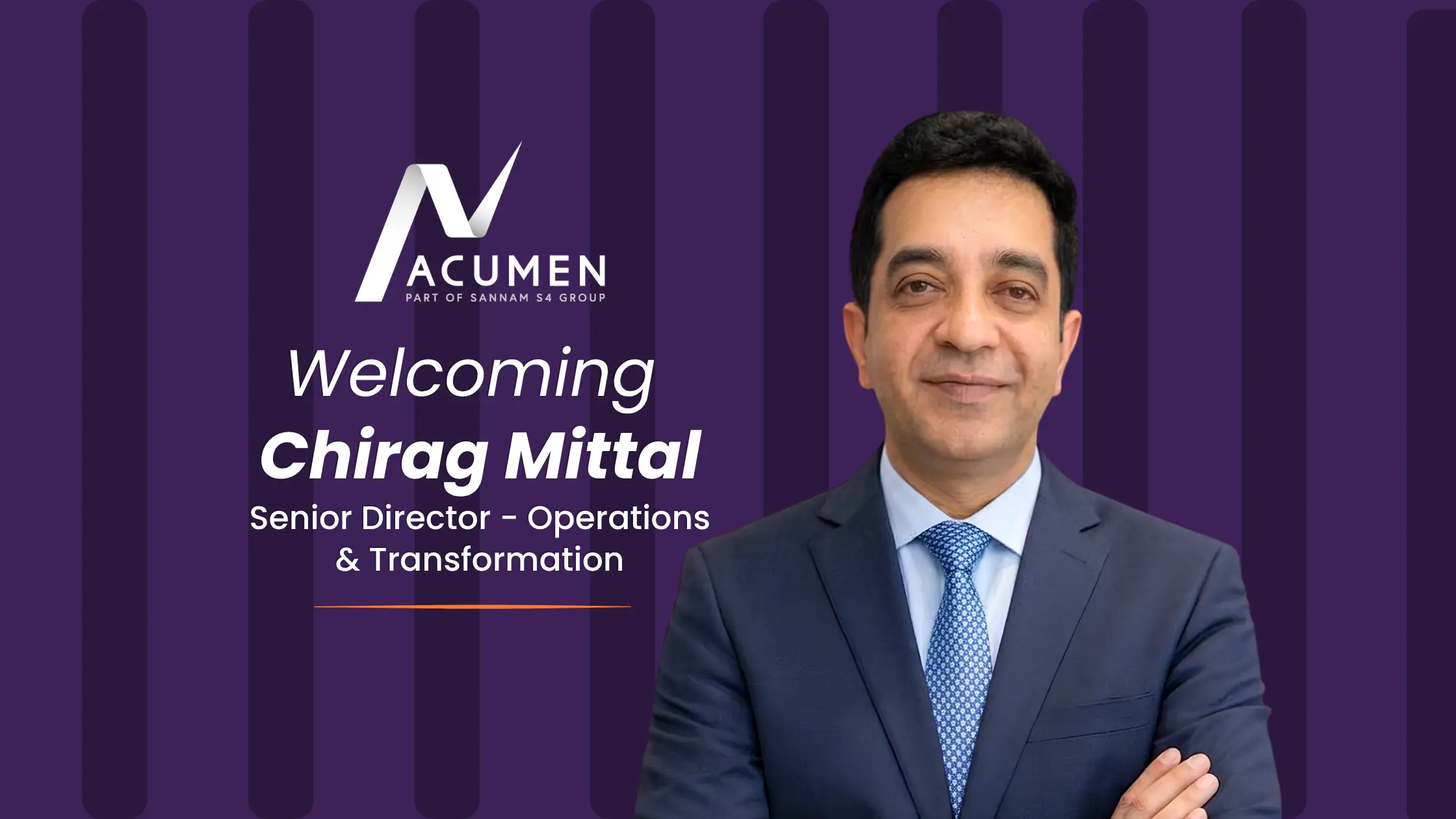
Acumen appoints Chirag Mittal as Senior Director – Operations & Transformation
September 30, 2026
We are delighted to welcome Chirag Mittal to Acumen as Senior Director – Operations & Transformation, based in New Delhi and working across...

From mobility shock to strategy-led TNE
September 16, 2026
A recurring theme in my recent conversations on international education has been the growing friction in traditional student mobility. I increasingly think the...